
A simple refractor needs only two lenses and a tube. Building one is a classic science project - and a good way to understand every telescope.
The two lenses
- Objective: a large, weak convex lens at the front. It gathers light and forms an image at its focal point. Its focal length is long - for example 600 or 900 mm.
- Eyepiece: a small, strong lens (or lens group) near your eye that magnifies that image. Its focal length is short - for example 16 or 25 mm.
Getting the distance right
For a sharp image, the eyepiece sits roughly one objective focal length plus one eyepiece focal length from the objective. A 600 mm objective with a 16 mm eyepiece needs about 616 mm between them - a sliding inner tube (a draw tube) lets you focus.
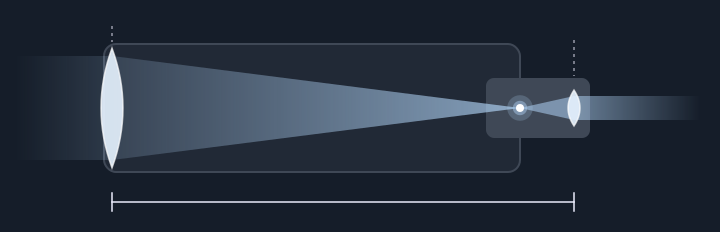
- Objective lens
- 600 mm
- Focal length of the large, weak front lens
- Eyepiece
- 16 mm
- Focal length of the small, strong lens
- Lens spacing
- about 616 mm
- 600 + 16. Slide the inner tube to focus
Magnification
Magnification = objective focal length / eyepiece focal length. 600 mm / 16 mm = about 38x - plenty for lunar craters and Jupiter's moons.
Why the view is upside down
This two-convex-lens design (a Keplerian telescope) turns the image upside down. That does not matter for the sky.
Better lenses, better views
- A single simple lens shows colour fringes around bright objects. An achromatic doublet objective (two lenses cemented together) reduces them greatly.
- A larger objective collects more light, but needs a longer tube to keep the colour and sharpness under control.
- Blacken the inside of the tube and add baffles (rings) to cut stray light.
Safety
Never point any home-made telescope at the Sun.
Build one with others
Pakistan Science Club runs hands-on making at its makerspace in Korangi, Karachi, including DIY telescopes. Telescope-making lenses and kits are in astronomy gear.