
A Newtonian reflector uses two mirrors: a large primary at the bottom of the tube and a small, tilted secondary near the top. If they are not lined up with each other and with the focuser, stars look like smudges and planets never become sharp. Lining them up is called collimation. Travel and knocks upset it, so check it every few sessions.
Do you need to collimate?
Point at a bright star, centre it at high magnification and turn the focus slightly out. You see a bright ring with a dark shadow in the middle (the secondary mirror). If the shadow sits in the centre of the ring, the telescope is collimated. If it is off to one side, collimate.

- Needs collimating
- The dark shadow sits off to one side
- Collimated
- The shadow is in the centre of the ring
What you need
- A collimation cap (a cap with a small central hole) or a laser collimator. A laser must itself be accurate - rotate it in the focuser: the dot on the primary should not move in a circle.
- A small screwdriver or Allen key for the secondary screws, and daylight or a lamp.
- Most primary mirrors have a small centre spot; it is a target, not a defect.
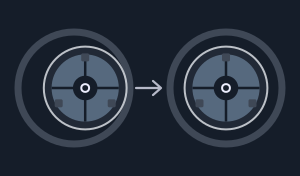
- Before
- Secondary off to one side in the focuser
- After
- Round and centred
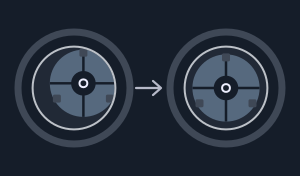
- Before
- The primary's reflection is off-centre
- After
- Whole primary centred, all three clips in view
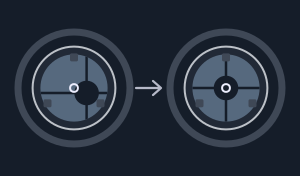
- Before
- The secondary's shadow is off the centre spot
- After
- Shadow centred on the centre spot
Step 1 - Centre the secondary under the focuser
Point the tube horizontally. Look through the cap. The secondary should appear round and centred in the focuser. If not, adjust the secondary's central bolt (moves it up and down the tube) and rotate it gently. Most telescopes keep this setting for years.
Step 2 - Tilt the secondary towards the primary
Adjust the three small screws on the secondary holder, a quarter-turn at a time, until the reflection of the whole primary mirror is centred in the secondary. With a laser: until the red dot lands on the primary's centre spot.
Step 3 - Tilt the primary
At the bottom of the tube the primary cell has adjustment screws and locking screws. Loosen the locking screws slightly. Adjust the others until the reflection of the secondary (or the returning laser dot) sits in the centre - with a laser, until the dot returns to the centre of the laser's target. Retighten the locking screws gently and check again.
Confirm on a star
Repeat the defocused-star test. Small corrections with the primary screws while looking at the star give the best result.
Good habits
- Make small turns and check after each one.
- Never touch the mirror surfaces.
- Short, fast telescopes (f/5 and below) need more careful collimation than long ones.
If a mirror is loose, a screw is stripped or the view does not improve, request a service check.