
Telescope names mix two different things: the optics (how light is gathered) and the mount (how the telescope is held and pointed).
Optics
Refractor - a lens at the front, like a long spyglass.
- Sealed tube, no mirror alignment, ready quickly.
- Small apertures are affordable; large ones become expensive.
- Simple lenses show a faint colour fringe on bright objects.
Newtonian reflector - a concave mirror at the bottom and a small flat mirror near the top send light to an eyepiece on the side.
- The most aperture for the money - the design used by the Made in Pakistan telescopes.
- Needs occasional collimation.
- Open tube: takes time to cool at night.
Catadioptric (e.g. Schmidt-Cassegrain, Maksutov) - mirrors plus a corrector lens in a short tube.
- Compact and portable for their focal length; often on GoTo mounts.
- Cost more per millimetre of aperture.
Mounts
Dobsonian - a Newtonian on a simple rotating base. Easiest to use and the best value for visual observing. You nudge it to follow objects.
Alt-azimuth - moves up-down and left-right, like a camera tripod head. Simple; good for small telescopes.
Equatorial - one axis lines up with the Earth's axis so one knob follows the sky. Smoother tracking and needed for most astrophotography, but more to learn.
GoTo - a motorised mount (alt-az or equatorial) with a hand controller or app that finds and tracks objects after a short alignment.
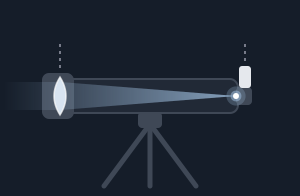
- Lens at the front
- Sealed tube, no mirrors to align
- Eyepiece at the back
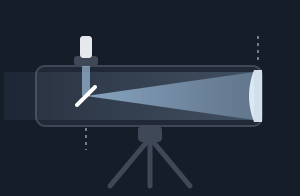
- Main mirror
- Curved, at the bottom of the tube
- Small flat mirror
- Sends the light out to the side
- Eyepiece on the side
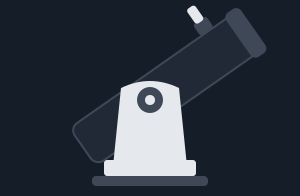
- Newtonian tube
- Rocker base
- Push the tube to point it
So which one?
- First telescope, mostly visual: a 114-200 mm Newtonian on a Dobsonian mount.
- Very portable, quick looks: a small refractor.
- Finding objects in bright city skies: GoTo helps when few stars are visible.
- Astrophotography: an equatorial tracking mount matters more than the telescope - start with the phone and Moon guide.