
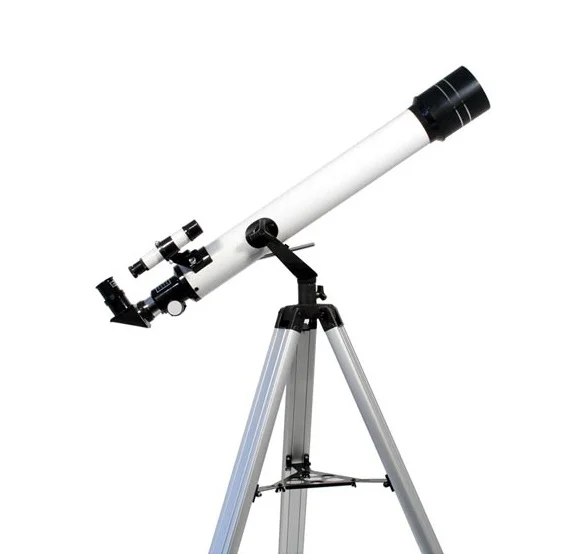
Visionking 70/700 Refractor Telescope
A 70 mm f/10 refractor on a full-height alt-azimuth tripod: a long, simple tube for the Moon and the bright planets, supplied with a finder, a diagonal and two eyepieces.
Rs 49,000
Available on back order- Works as a first telescope
- Strong on the Moon
- Usable from city skies
- 70 mm Aperture
- 700 mm Focal length
- Refractor Optical design
- Alt-azimuth Mount
- Beginners, Moon Best for
- Beginner Experience level
Where it works best
- Beginner friendly Excellent
- Moon Excellent
- Planetary Good
- Deep sky Limited
- Astrophotography Not suitable
- Portability Good
- Urban / light-pollution use Good
- School use Good
What can you see?
Through the eyepiece with this aperture - not processed astrophotography.
- The Moon Excellent Hundreds of craters, mountain ranges and valleys, most striking along the terminator - the line between lunar day and night, where shadows are longest.
- Jupiter Good A small disc crossed by two dark cloud belts, and the four Galilean moons - Io, Europa, Ganymede and Callisto - as points of light that change position from night to night.
- Saturn Good The rings are clearly visible at modest magnification, around 50x, together with Titan, its largest moon, as a faint point nearby.
- Mars Good A small orange disc. Near a close approach, a white polar cap and dark surface markings may be glimpsed.
| Aperture | 70 mm |
|---|---|
| Focal length | 700 mm |
| Focal ratio | f/10.0 (calculated from aperture and focal length) |
| Optical design | Refractor |
| Mount | Alt-azimuth |
| Tracking | None (manual) |
| GoTo | No |
| Eyepiece barrel | 1.25" |
| Finder | 5x24 optical finder |
| Assembled weight | 4.0 kg |
| Recommended experience | Beginner |
- Visionking 70/700 optical tube
- 25 mm eyepiece
- 10 mm eyepiece
- 5x24 finder scope with bracket
- Mirror star diagonal
- Alt-azimuth mount with aluminium tripod
- User manual
Before you buy
-
70 mm is a small aperture. The Moon and the bright planets are rewarding; faint galaxies and nebulae are not what this telescope is for.
-
No Barlow lens and no smartphone adapter are in the box - it holds the tube, the two eyepieces, the finder, the diagonal and the mount.
-
The tube is about 70 cm long. The kit is light, but this is not a grab-and-go telescope.
-
The 5x24 finder is basic. Align it in daylight, on a distant fixed object, before your first night.
-
There is no tracking. Objects drift out of view and you nudge the tube by hand, which takes practice at 70x.
-
Not for astrophotography beyond holding a phone to the eyepiece for the Moon.
Frequently asked questions
What magnification does it give?
The supplied 25 mm eyepiece gives 28x and the 10 mm gives 70x. Both are comfortable for a 70 mm lens. Around 100x is the practical limit in ordinary city air, and about 140x in excellent conditions - the large numbers printed on boxes of telescopes this size are past the point where magnification stops adding detail.
Can I see Saturn's rings with this telescope?
Yes. At 70x Saturn shows as a small disc with its rings clearly separated from the planet. It is unmistakable, but it stays small, and finer detail such as the Cassini Division is not a realistic expectation at 70 mm.
Is this or the 70/300 the better first telescope?
They are the same aperture and answer different questions. This one is longer and steadier on the Moon and the planets and stands on a full tripod. The 70/300 is short, packs away easily and gives a wider field, but reaches lower magnification and is more affected by false colour. Choose this one if the telescope will live at home; choose the 70/300 if it has to travel.
Does it need collimation?
No. A refractor normally holds its optical alignment, which is one reason it is easier for a beginner than many reflectors at the same price.
Will it work from inside a city?
For the Moon and the bright planets, yes - light pollution barely affects them, and those are what this telescope is best at. Faint deep-sky objects are a different matter and need a darker site.
Can I add better eyepieces later?
Yes. The focuser takes the standard 1.25 inch barrel, so ordinary eyepieces, filters and diagonals will fit.
Full description
The Visionking 70/700 is a refractor with a 70 mm objective lens and a 700 mm focal length, which makes it an f/10 telescope - the long, slow tube that has been the standard beginner's refractor for decades. It arrives complete: an alt-azimuth mount on a full-height aluminium tripod, a 5x24 finder, a star diagonal and two eyepieces.
The long focal length is the point of it. At f/10 simple eyepieces perform better than they do in a short tube, the false colour that small refractors show around bright objects is less obvious, and the supplied eyepieces reach a magnification a 70 mm lens can actually carry. The Moon shows craters, mountain ranges and shadow detail along the terminator. Jupiter shows its four bright moons, and on a steady night its two main cloud belts. Saturn shows as a small disc with the rings clearly separated from the planet. What you give up is field of view and convenience: the tube is about 70 cm long, so this is a telescope you carry out and set up rather than one you slip into a bag.
Who it suits: beginners buying a first telescope, families and schools who want an instrument that stands on its own tripod at a sensible height, and anyone whose main interest is the Moon and the planets. It is not the right choice for faint deep-sky observing, for long-exposure astrophotography, or for a buyer who wants the widest possible star fields - a 70 mm at f/10 is a planetary tube, not a rich-field one.
About magnification, plainly. Magnification is not a fixed property of a telescope - it depends on which eyepiece you fit, and any telescope can be pushed to any number you like. What actually limits it is the aperture. With this telescope's 700 mm focal length, the 25 mm eyepiece gives 28x and the 10 mm gives 70x. Both sit comfortably within what a 70 mm lens can do, which is the real advantage of a long tube: you reach useful planetary magnification with ordinary eyepieces. The theoretical ceiling for 70 mm is around 140x in excellent conditions, and in ordinary city air anything much above 100x gives a dim, unsteady image. Figures such as 525x, printed on the boxes of telescopes this size, are well past the point where more magnification stops adding detail.
Setup is straightforward, with one step worth doing in daylight: align the 5x24 finder on a distant fixed object - a pole, a rooftop aerial - before your first night, or finding anything in the dark will be frustrating. After that, fit the diagonal and the 25 mm eyepiece, start on the Moon, and change to the 10 mm only once the target is centred and the air is steady. A refractor holds its optical alignment, so there is no routine collimation to learn.
This is an imported Visionking telescope, not one of our Made in Pakistan models. We stock imported telescopes where they fill a real gap, and here it is the classic long refractor at an entry-level price. If you want more light-gathering for the money and stronger deep-sky performance, compare it with our Made in Pakistan reflectors before deciding.
Customer reviews
Written by people who bought this from us. Every review is checked before it appears.
No reviews yet. Be the first to review this telescope.
If you own this one, yours would be the most useful thing on the page for the next buyer.