
Visionking 90/650 Refractor Telescope
A 90 mm refractor on an alt-azimuth tripod, a step up from our children's model: enough aperture for Saturn's rings and Jupiter's cloud bands.
Rs 79,000
Available on back order- Strong on the Moon
- Usable from city skies
- Suits school groups
- 90 mm Aperture
- 650 mm Focal length
- Refractor Optical design
- Alt-azimuth Mount
- Moon Best for
- Beginner Experience level
Where it works best
- Beginner friendly Good
- Moon Excellent
- Planetary Good
- Deep sky Limited
- Astrophotography Not suitable
- Portability Good
- Urban / light-pollution use Good
- School use Good
What can you see?
Through the eyepiece with this aperture - not processed astrophotography.
- The Moon Excellent Hundreds of craters, mountain ranges and valleys, most striking along the terminator - the line between lunar day and night, where shadows are longest.
- Jupiter Good A small disc crossed by two dark cloud belts, and the four Galilean moons - Io, Europa, Ganymede and Callisto - as points of light that change position from night to night.
- Saturn Good The rings are clearly visible at modest magnification, around 50x, together with Titan, its largest moon, as a faint point nearby.
- Mars Good A small orange disc. Near a close approach, a white polar cap and dark surface markings may be glimpsed.
| Aperture | 90 mm |
|---|---|
| Focal length | 650 mm |
| Focal ratio | f/7.2 (calculated from aperture and focal length) |
| Optical design | Refractor |
| Mount | Alt-azimuth |
| Tracking | None (manual) |
| GoTo | No |
| Eyepiece barrel | 1.25" |
| Finder | Optical finder scope, non-illuminated |
| Assembled weight | 4.0 kg |
| Recommended experience | Beginner |
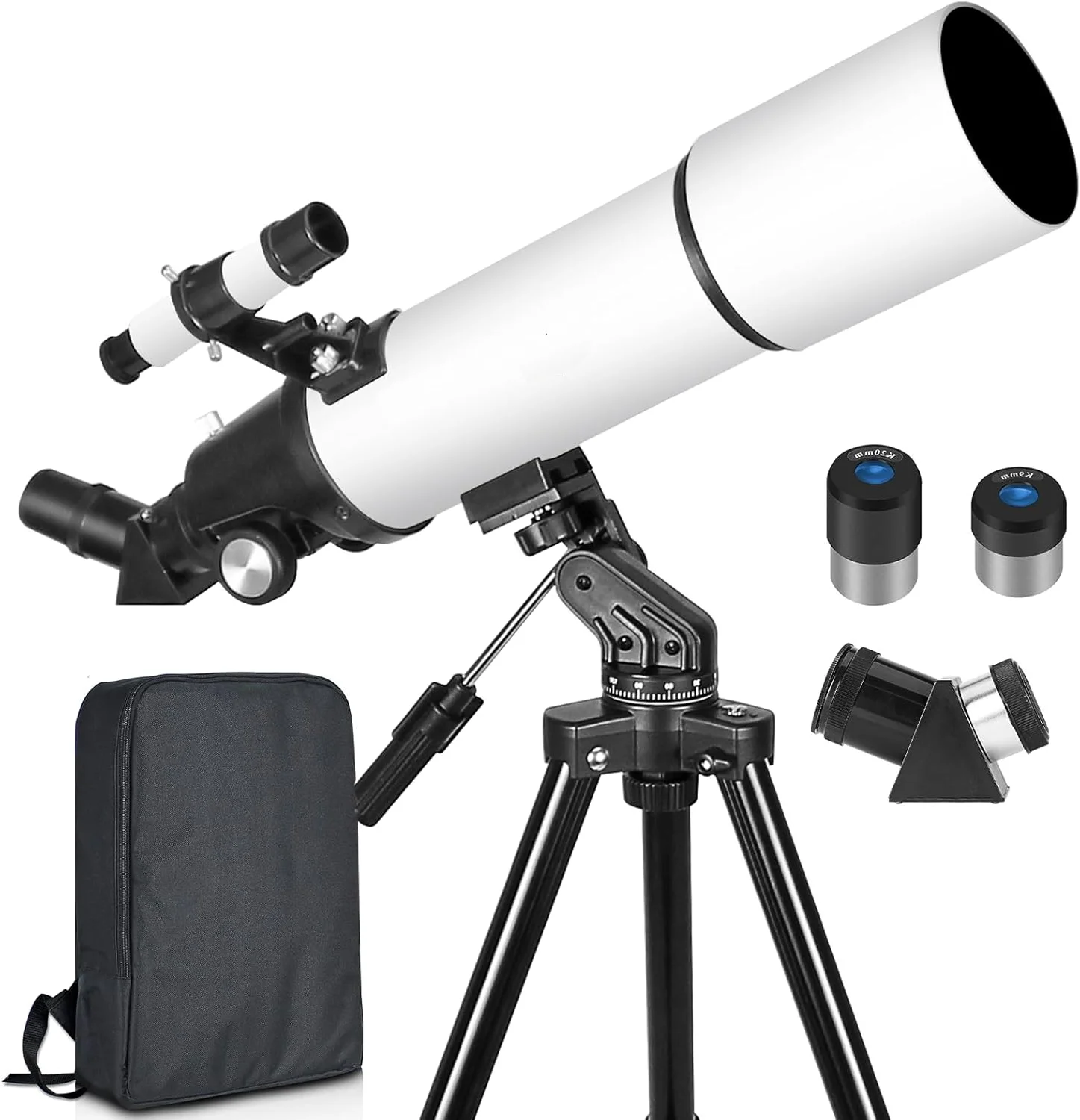
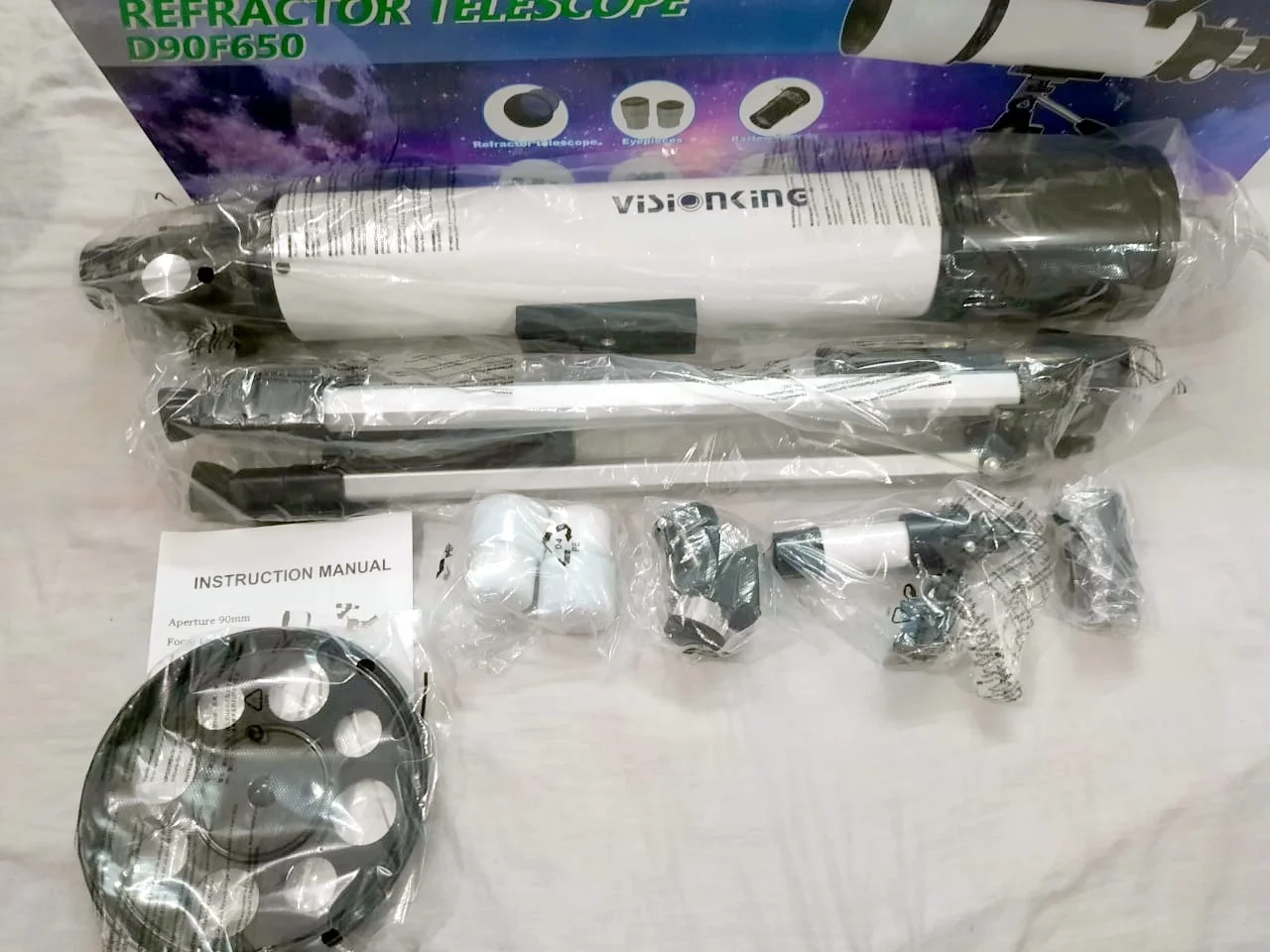
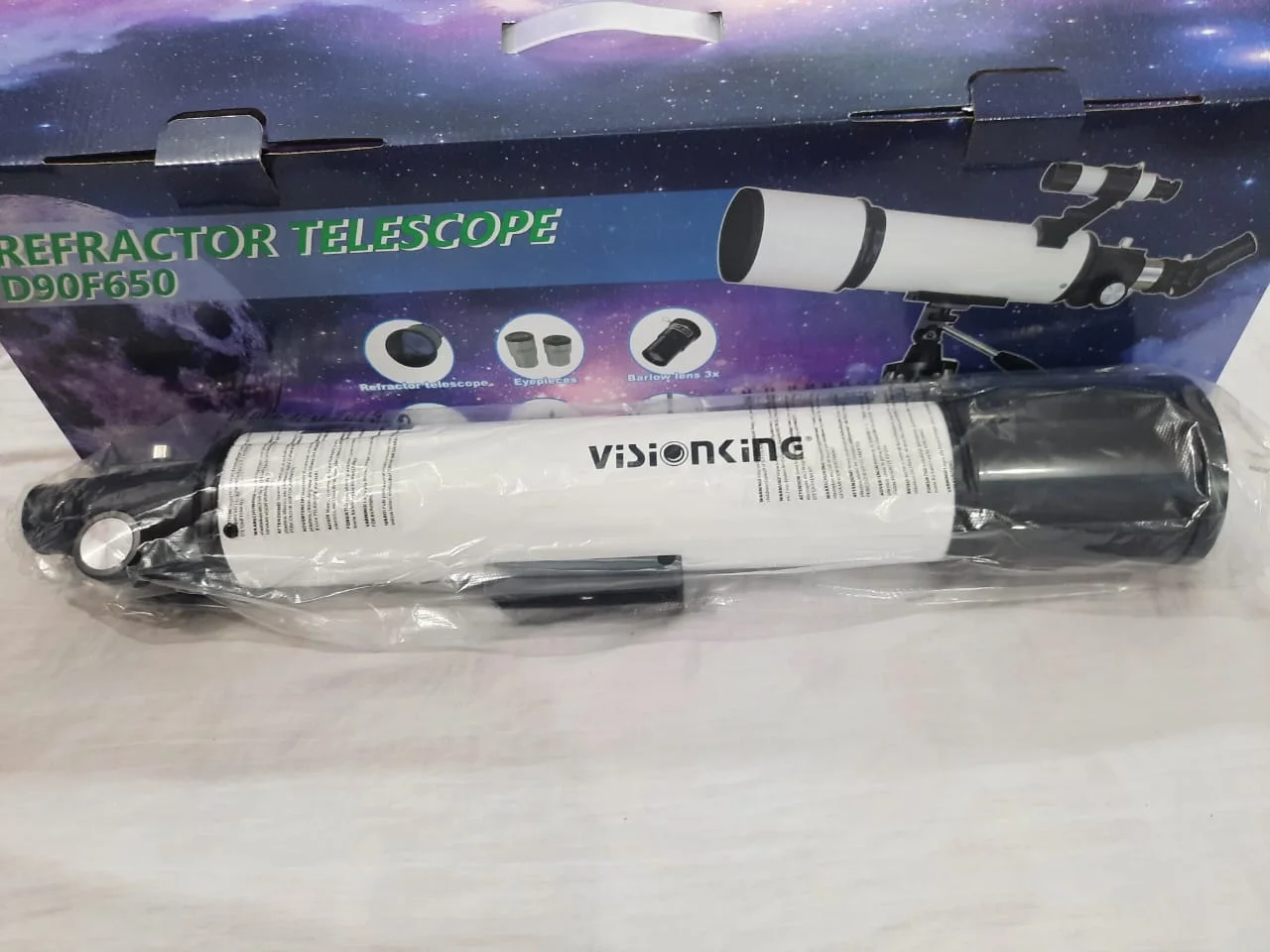
- Visionking D90F650 optical tube
- Optical finder scope
- Star diagonal
- 25 mm eyepiece
- 10 mm eyepiece
- 3x Barlow lens
- Alt-azimuth photographic tripod
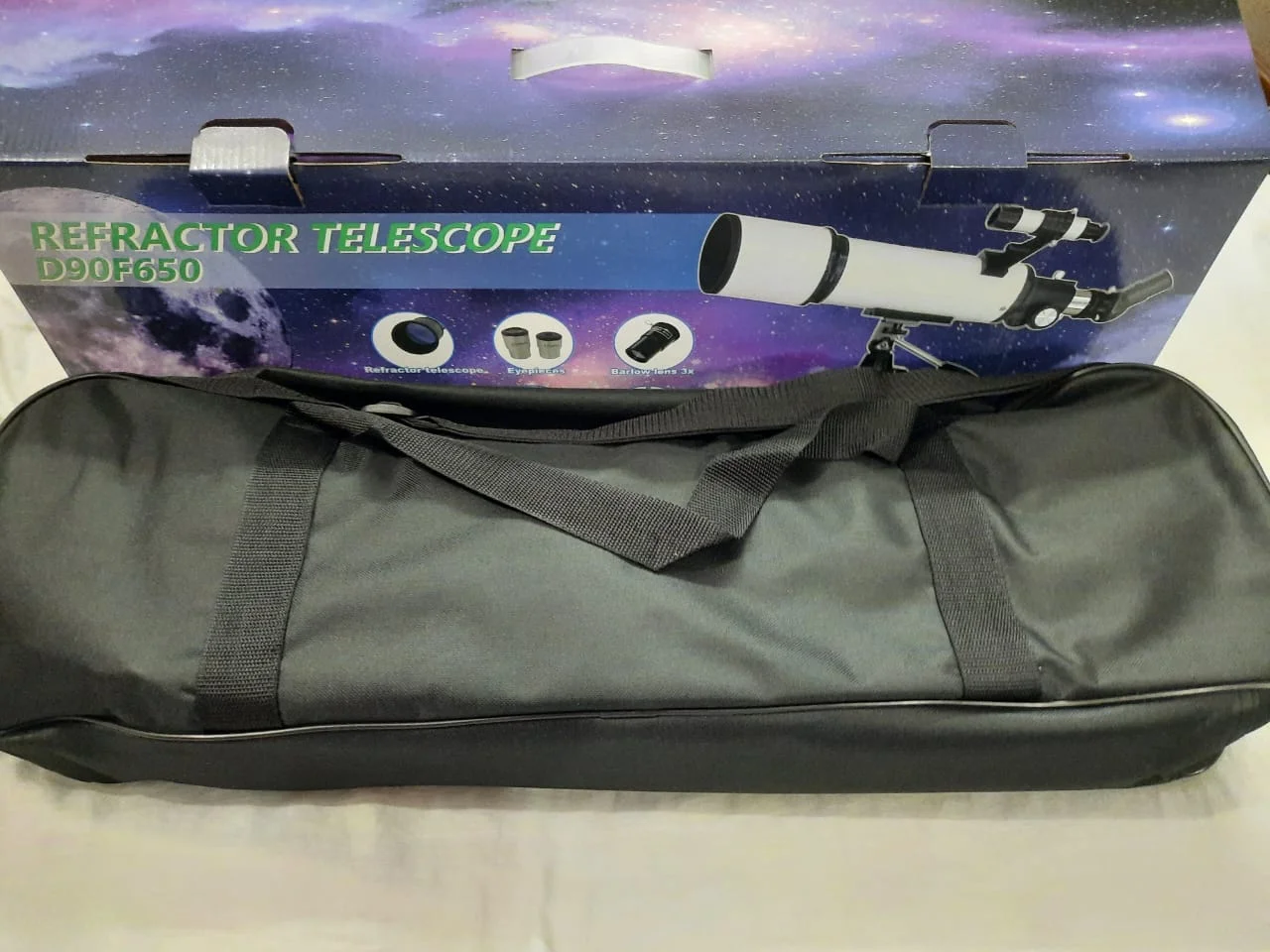
- Carry backpack
Before you buy
-
Never point it at or near the Sun, and do not leave anyone observing during the day unsupervised. A 90 mm lens concentrates enough sunlight to injure an eye instantly.
-
Saturn's rings show separated and Jupiter's four moons are clear; deep-sky objects such as the Orion Nebula stay faint grey patches, not photograph-like colour.
-
The 3x Barlow pushes the 10 mm eyepiece to about 195x, above the practical ceiling for a 90 mm lens most nights. Most viewing happens at 26x or 65x.
-
No tracking, so objects drift out of view and you nudge the tube by hand every minute or so.
-
Alt-azimuth tripod, not equatorial - simple to point, no polar alignment needed.
-
There is a small optical finder scope to align with the main tube before first use.
-
Imported model, supplied without a manufacturer warranty. Currently supplied on back order.
Frequently asked questions
What will I actually see?
The Moon in detail at any power: craters, mountain ranges, sharp shadows along the terminator. Saturn as a disc with its rings clearly separated. Jupiter with its four bright moons and, on a steady night, a hint of cloud banding. The Orion Nebula, the Pleiades and the Andromeda Galaxy are reachable but appear as faint grey patches or a scatter of stars, not as colour images.
Is this for kids or adults?
It is marketed and sized for an adult beginner. At about 5 kg packed it is heavier than our 50 mm children's telescope, and setting up the tripod and aligning the finder scope suit an adult more than a young child working alone.
What magnification does it give?
The 25 mm eyepiece gives about 26x and the 10 mm gives about 65x. With the included 3x Barlow those become roughly 78x and 195x - the highest is beyond the practical ceiling for a 90 mm lens most nights. Most evenings are spent at 26x or 65x.
Equatorial or alt-azimuth mount?
Alt-azimuth: point it up-down and left-right, the way a camera tripod works. There is no polar alignment to learn, but also no motor, so you nudge the tube by hand to keep an object in view.
Does it need collimation, batteries or a phone?
None of the three. A refractor holds its alignment, nothing in the kit is powered, and it is used by eye at the eyepiece.
Will it work from inside a city?
Yes, for the Moon and the bright planets - light pollution barely affects them. Faint deep-sky objects need a dark sky regardless of aperture.
Full description
The Visionking D90F650 is a 90 mm refractor on a simple alt-azimuth tripod, a step up in aperture from our 50 mm children's model. The tube is 650 mm long, the mount has no motor or tracking, and the whole kit - tube, tripod, eyepieces and a 3x Barlow - packs into its own carry bag.
What it is good at is the Moon and the brighter planets. On a steady night, Saturn's rings show separated from the disc rather than as a single blur, and Jupiter's four bright moons sit clearly beside the planet with the first hint of cloud banding. The Moon is excellent at any of the supplied powers, with craters and mountain ranges standing out sharply along the terminator.
Be clear about what 90 mm cannot do. The Orion Nebula, the Pleiades and the Andromeda Galaxy are within reach, but as faint grey patches or a scatter of stars picked out against a dark sky - not as the colour a camera records over a long exposure. Nothing at the eyepiece looks like an astrophotography image; that needs a tracking mount and a camera, and this kit has neither.
About magnification, plainly. The 25 mm eyepiece gives about 26x and the 10 mm gives about 65x; with the 3x Barlow those become roughly 78x and 195x. The last of these sits above the practical ceiling for a 90 mm lens on most nights - usable only in exceptional seeing, dimmer and softer the rest of the time. Expect to spend most evenings at 26x or 65x, with the Barlow kept for the Moon on a calm night.
Using it is straightforward but not instant. The alt-azimuth tripod needs no polar alignment - point it and go - but there is a small optical finder scope to line up with the main tube before the first session, and objects drift out of the eyepiece without a motor, so the tube needs nudging by hand every minute or so. There is nothing to collimate and no batteries to charge.
One rule matters more than every other: never point this or any telescope at or near the Sun, and do not leave anyone observing during the day unsupervised. A 90 mm lens concentrates enough sunlight to cause permanent eye injury in an instant.
This is an imported Visionking telescope, not one of our Made in Pakistan models. Ninety millimetres is a genuine step up from a children's telescope and a reasonable choice for an adult beginner, but if deep-sky detail or long-term upgrading matters to you, our Made in Pakistan reflectors give more aperture for the money and start not far above this price.
Customer reviews
Written by people who bought this from us. Every review is checked before it appears.
No reviews yet. Be the first to review this telescope.
If you own this one, yours would be the most useful thing on the page for the next buyer.