
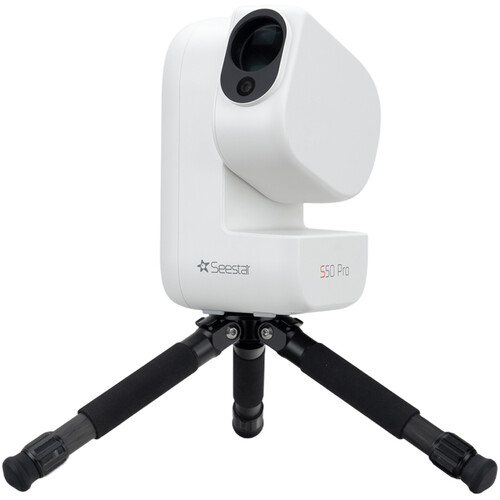
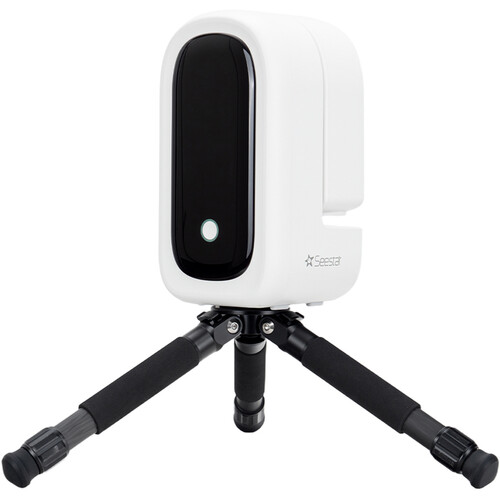
ZWO Seestar S50 Pro Smart Telescope
ZWO Seestar S50 Pro smart telescope in Pakistan: finds, tracks and photographs nebulae and galaxies from your phone, with a filter for city skies.
Rs 299,000
Available on back order- Works as a first telescope
- Genuinely portable
- Finds objects for you
- 50 mm Aperture
- 260 mm Focal length
- Refractor Optical design
- Alt-azimuth Mount
- Beginners, Astrophotography Best for
- Beginner Experience level
Where it works best
- Beginner friendly Excellent
- Moon Good
- Planetary Limited
- Deep sky Good
- Astrophotography Excellent
- Portability Excellent
- Urban / light-pollution use Good
- School use Excellent
What can you see?
Through the eyepiece with this aperture - not processed astrophotography.
- The Moon Good Hundreds of craters, mountain ranges and valleys, most striking along the terminator - the line between lunar day and night, where shadows are longest.
- Jupiter Limited A small disc crossed by two dark cloud belts, and the four Galilean moons - Io, Europa, Ganymede and Callisto - as points of light that change position from night to night.
- Saturn Limited The rings are clearly visible at modest magnification, around 50x, together with Titan, its largest moon, as a faint point nearby.
- Mars Limited A small orange disc. Near a close approach, a white polar cap and dark surface markings may be glimpsed.
| Aperture | 50 mm |
|---|---|
| Focal length | 260 mm |
| Focal ratio | f/5.2 (calculated from aperture and focal length) |
| Optical design | Refractor |
| Mount | Alt-azimuth |
| Tracking | Motorized tracking |
| GoTo | Yes |
| Eyepiece | None - camera telescope, no eyepiece |
| Focuser | Motorised autofocus |
| Finder | Built-in wide-angle camera, 63 degree field |
| Mount interface | 3/8-16 tripod thread |
| Assembled weight | 2.8 kg |
| Recommended experience | Beginner |
- Seestar S50 Pro smart telescope
- Tripod
- Magnetic solar filter
- USB-C charging cable
- Carry case
- Quick start guide
Before you buy
-
Price includes all import duties and taxes. Only delivery is added at checkout, with no other charges.
-
You do not look through it. Everything is seen on your phone or tablet as a stacked photograph that improves over a few minutes.
-
Best on nebulae, galaxies and star clusters. Jupiter and Saturn come out small; the Moon photographs well.
-
The built-in dual-band filter helps with emission nebulae from cities like Karachi and Lahore. Galaxies still look much better from a dark site.
-
Never point it at the Sun without the magnetic solar filter fitted.
-
Runs from its own battery (rated up to 9 hours) or USB-C power, including a power bank during load-shedding.
-
Rated for use up to 40 degrees C, so on the hottest summer nights wait until the evening has cooled.
-
Needs the free Seestar app on an Android or iOS phone, and the phone's location for GPS.
-
Imported ZWO instrument, not one of our Made in Pakistan telescopes. Supplied on back order, with no manufacturer warranty; our 7-day replacement applies.
Frequently asked questions
Can I look through it like a normal telescope?
No. There is no eyepiece. The Seestar is a camera on a motorised mount, and you see everything on your phone or tablet as a photograph that builds up over a few minutes of stacking.
Does the price include customs duty and taxes?
Yes. The price shown already includes all import duties and taxes. The only thing added at checkout is delivery to your city; nothing else is charged on top.
Will it work from a city like Karachi, Lahore or Islamabad?
Yes, for emission nebulae such as the Orion and Lagoon nebulae, where the built-in dual-band filter cuts through much of the light pollution, and for the Moon and bright star clusters. Galaxies are fainter and show far more detail from a darker sky outside the city.
Can it show planets?
It can photograph them, but small. At 260 mm focal length Jupiter shows its moons and cloud bands as a small disc, and Saturn its rings at a small size. For planetary detail a larger conventional telescope is the better choice.
How long does the battery last, and what about load-shedding?
ZWO rates the 10,000 mAh battery at up to 9 hours in warm weather, measured in the lab. It also runs and charges from USB-C at 5V/3A or 12V/3A, so a good power bank or a 12V supply keeps it going when the mains is off.
Can I use it in Pakistani summer heat?
ZWO rates it for -10 to 40 degrees C. Most nights are within that, but on the hottest summer nights in Sindh and southern Punjab wait until the evening has cooled down, and do not leave it standing in the sun before a session.
Do I need to know the night sky to use it?
No. You pick an object in the app and the telescope levels itself, works out where it is pointing, finds the object and focuses automatically. That is why it suits families, schools and beginners who want photographs straight away.
Can it photograph the Sun?
Only with the supplied magnetic solar filter fitted over the lens, for the whole session. Without it, sunlight damages the sensor in seconds. Never look at the Sun yourself.
Full description
The Seestar S50 Pro is not a telescope you look through. It is a 50 mm camera-telescope on its own motorised mount: you choose an object in the Seestar app on your phone, and it levels itself, works out where it is pointing, slews to the target, focuses and starts taking short exposures. It stacks those frames as it goes, so the picture on your screen gets cleaner and more detailed the longer you leave it, and you save the result to your phone.
Inside is a 4-element apochromatic lens with ED glass, 50 mm across with a 260 mm focal length (f/5.2), in front of an 8.3-megapixel OmniVision OS08B10 sensor. The field of view is 2.8 degrees on the long side, about five full Moons, which suits large nebulae, galaxies and star clusters. A second, wide-angle camera with a 63-degree view helps the telescope find its place in the sky and shows where it is pointing.
The filter that matters most in Pakistan is the built-in dual-band light-pollution filter, which passes the hydrogen-alpha and oxygen-III light that emission nebulae give off. From a rooftop in Karachi or Lahore it can bring out the Orion Nebula, the Lagoon and the Veil, which are hard to show at all from a city by eye. It does much less for galaxies, which shine in ordinary starlight. Andromeda still shows from a city, but a drive out to a darker sky makes a clear difference to every galaxy.
Be clear about what it is not. It is not a planetary telescope: at 260 mm focal length Jupiter and Saturn come out as small discs, the rings and cloud bands visible but tiny. The Moon fills a good part of the frame and photographs well. What you see is a processed, stacked image on a screen, built up over minutes. Nobody puts an eye to this telescope, and nobody with a conventional telescope sees colour like this through an eyepiece.
For daytime and solar use it comes with a magnetic solar filter. Never point the Seestar at the Sun without that filter fitted, and keep it on for the whole session. Unfiltered sunlight damages the sensor in seconds.
Power is practical for local conditions. The 10,000 mAh battery is rated by ZWO at up to 9 hours (a lab figure, in warm weather), and the telescope charges or runs from USB-C at 5V/3A or 12V/3A, so a good power bank keeps it going through load-shedding or at a dark site with no mains. ZWO rates it for -10 to 40 degrees C. On the hottest summer nights in Sindh and southern Punjab the air can stay above that limit well after dark, so an evening that has cooled down is the time to use it. It stores about 100 GB of images on board and connects to the phone over 5 GHz or 2.4 GHz Wi-Fi.
It weighs 2.8 kg and folds to 140 x 149 x 268 mm, so it travels in a carry case to a farmhouse, a hill station or a school field. Set-up takes a few minutes and needs no knowledge of the sky, which makes it a good first instrument for a family, a school or anyone who wants deep-sky photographs without learning a mount and camera first. It also has an equatorial mode for longer exposures, which needs accurate polar alignment.
This is an imported ZWO instrument, sold on Telescopes.pk alongside our Made in Pakistan telescopes. If you want to look through an eyepiece yourself and see the planets in more detail, one of our reflectors suits you better. If you want photographs of nebulae and galaxies with almost no learning curve, the Seestar is the more direct route.
Customer reviews
Written by people who bought this from us. Every review is checked before it appears.
No reviews yet. Be the first to review this telescope.
If you own this one, yours would be the most useful thing on the page for the next buyer.